 velvet oracle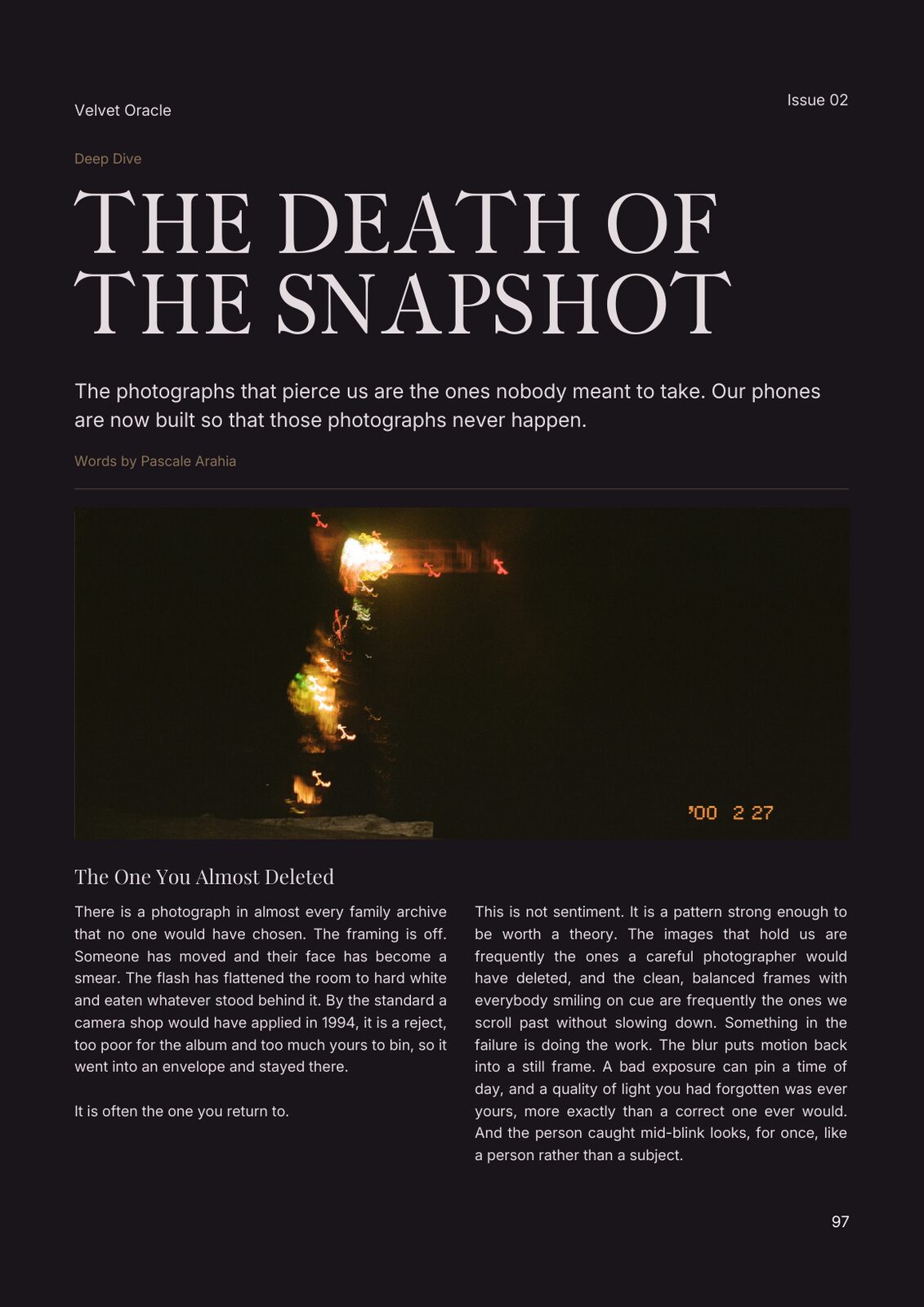
The photographs that pierce us are the ones nobody meant to take. Our phones are now built so that those photographs never happen.
Deep Dive / Issue 02. Words by Pascale Arahia.
The One You Almost Deleted
There is a photograph in almost every family archive that no one would have chosen.
The framing is off. Someone has moved and their face has become a smear. The flash has flattened the room to hard white and eaten whatever stood behind it. By the standard a camera shop would have applied in 1994, it is a reject, too poor for the album and too much yours to bin, so it went into an envelope and stayed there.
It is often the one you return to.
This is not sentiment. It is a pattern strong enough to be worth a theory. The images that hold us are frequently the ones a careful photographer would have deleted, and the clean, balanced frames with everybody smiling on cue are frequently the ones we scroll past without slowing down. Something in the failure is doing the work. The blur puts motion back into a still frame. A bad exposure can pin a time of day, and a quality of light you had forgotten was ever yours, more exactly than a correct one ever would. And the person caught mid-blink looks, for once, like a person rather than a subject.
For most of photography’s history this was a private observation, the sort of thing you noticed about your own shoebox and never generalised. Then a philosopher gave it a name.
What Barthes Was Pointing At
Roland Barthes wrote Camera Lucida in 1980, in the last months of his life, partly as a way of thinking about a photograph of his late mother. He split the way a photograph reaches us into two forces. The first he called the studium: the broad, trained interest a picture invites, the part you can read and discuss and place in a genre. You approach the studium with a kind of general goodwill. You find a photograph handsome, or historically useful, or well made. You like it. You do not feel it.
The second force he called the punctum. This is the detail that leaves the frame and reaches you, the small unbargained-for thing that pricks. A punctum is rarely what the photographer set out to record. It is a texture at the edge, a pair of shoes, a bad tooth, a hand held in a way the operator never noticed and could not have staged. It arrives by accident and it is personal. What punctures one viewer leaves the next unmoved, because the punctum is not a property of the picture so much as a wound the picture happens to open in you.
Hold on to the mechanism, because everything here turns on it. The punctum depends on contingency. It lives in the part of the image that no one controlled, the surplus the lens took in while the photographer was busy with the subject. Photography, for most of its life, could not help gathering this surplus. A camera is indiscriminate. Point it at a face and it also takes the wallpaper, the weather, the thing on the table you would never have thought to include. The accident came free with the exposure.
Barthes gave the medium one more property, and it turns out to matter most of all. A photograph, he argued, carries a certificate no other image can. It says: this was. The thing in front of the lens was really there, at a real instant, before a real shutter. He called this the that-has-been, and he thought it the essence of the form. A painting can invent. A sentence can lie. A photograph, by its mechanism, testifies that something existed and stood in that light. Whatever else it does, it insists on a past that happened.
That was the medium’s quiet gift, and it is precisely the gift the current camera is built to take back.
The Camera That Computes
Press the shutter on a modern phone and almost nothing about the result is a single record of a single instant. The device has been capturing frames before your thumb moved and keeps capturing them after. It merges a stack of exposures to hold both the bright window and the dim room. It runs noise reduction, sharpening, tone mapping. It finds faces and smooths them by default. It knows what a sky is and can lift it out. The photograph you receive a second later is a composite assembled by software toward an idea of what a good photograph looks like, and that idea was decided in advance, in a lab, by people optimising for a version of good that most users will accept without complaint.
None of this is opt-in in any real sense. The processing runs by default, the settings that govern it sit several menus deep, and the unedited frame the sensor recorded is never shown to you. What lands in your camera roll is already the edit, made before you had a chance to see the original.
Two features show the logic with unusual clarity.
In 2023 a Reddit user ran a clean test on Samsung’s much-advertised moon photography. He blurred a moon image until no real detail survived, put it on a screen, and photographed it across the room with a Galaxy phone’s long zoom. The result came back with crisp craters that were not in the source at all. A follow-up found the phone would even add lunar-looking texture to a plain grey disc. Samsung’s own explanation described a deep-learning engine trained to enhance the moon’s detail, and by 2025 the company was quietly reworking the feature to reduce confusion between photographing the real moon and photographing an image of it. The camera was not recording the moon in front of it. It recognised a moon-shaped thing and supplied the moon it already knew.
The second feature is gentler and, for this argument, more damning. Google’s Best Take, introduced on the Pixel 8 and since made automatic, solves the group-photo problem by letting you swap each person’s face between shots taken seconds apart, so everyone ends up with open eyes and a good expression at the same time. The latest version can scan up to a hundred and fifty frames and blend them with no input from you. The output is a moment that did not occur. Nobody in the room shared that expression at that instant. The software assembled the instant afterwards from parts. Google is untroubled by this. Its own product manager defends the composite on the grounds that it draws from pictures taken in quick succession, so, in her words, “it’s essentially the same moment.”
It is not the same moment. It is several moments edited into one that flatters everyone, and that difference is the whole of the matter. Remember the that-has-been, the photograph’s old certificate that this really happened. Best Take revokes it. The image no longer testifies to an instant that was lived. It testifies to an instant that was manufactured to look better than any that occurred. The blink is gone. So is the punctum, because the punctum was hiding in the blink.
Best Take is only the clearest case. The same phone will move a person across the frame, erase the stranger in the background, extend the edge of a photo with invented scenery, or composite you into a group shot you were never standing in because you were the one holding the camera. Each of these is sold as a fix. Each removes another scrap of the contingent world the lens gathered and replaces it with something a designer preferred.
Consider what all these systems are built to remove. Blur. Noise. Odd expressions. Poor exposure. Cluttered backgrounds. The stray element at the edge of frame. Read that list again with Barthes open beside you. It is a fairly complete inventory of where the punctum tends to live. The optimiser is not neutral about accident. The elimination of accident is its entire job, and it does that job well.
The old camera recorded what happened. The new one decides what should have.
Here is the turn, and here is the claim, stated so it can be argued with.
The old camera recorded what happened. The new one decides what should have.
The punctum depends on contingency, and computational photography is a machine for removing contingency, so the more heavily an image is computed, the less able it is to pierce. That is the claim, and it is not a safe one. It could be wrong in a way you could check. If the images people return to across the years turn out to be the optimised ones, the clean group shots and the corrected skies, rather than the flawed frames, the claim fails. If a fully computed picture can open a wound as reliably as a raw one, the claim fails. I am betting it cannot, and the bet is falsifiable, which is more than most opinions about photography manage.
The Shoebox and the Service
There is a second death folded inside the first, and it is about where the images go.
The shoebox was a poor archive and a good one. Poor, because it lost things. Prints faded, envelopes were mislaid, whole years went missing in a house move. Good, for the same reason. Scarcity did the editing. Film cost money to buy and money to develop, so you shot on a small budget of attention, twenty-four or thirty-six frames at a time, and most of what survived survived because someone had bothered to print it. The archive was finite and physical and yours. It sat in a cupboard and asked nothing of you. It could not send you a bill.
The service reverses every one of those terms, and I will spend my one comparison here rather than scatter smaller ones through the piece. Storage is effectively unlimited, so nothing is edited by scarcity, and the default becomes to keep every frame of every burst, the trillions of near-duplicates included. In 2026 humanity is on track to take close to two trillion photographs across the year, around ninety-four per cent of them on phones. Google Photos alone reportedly holds something on the order of nine trillion images. The archive is no longer a box you own but a library you rent, and the rent is the point. Access is contingent on a subscription that renews forever.
The shoebox lost your photographs through neglect, and neglect is a loss you can at least grieve. What the service does is different in kind. It can hold the images behind a payment that never ends, and once you stop and drift over the free tier, the syncing stops and, given enough time, the material above that tier can be restricted or cleared. The loss now arrives with an invoice attached.
Something quieter changes with the shift from box to cloud, harder to see than the money. When everything is kept, nothing is chosen, and choosing was half of what made an image matter. The print in the frame on the wall earned its place by being selected out of thirty-five others on the roll. The single image on the service is one swipe among ten thousand, weighted by an algorithm that surfaces your “memories” on a schedule and calls that curation. Abundance is not the same as richness. A cupboard holding forty photographs, each one printed because it counted, can carry more of a life than a phone holding forty thousand that no one will ever look at twice.
Where the Argument Could Break
An honest version of this case has to meet its own objections, so here are the strongest ones.
The first: computation produces accidents too. The moon square that came back wearing craters is itself uncanny, a machine hallucination with a strange pull of its own. Conflicting algorithms glitch. Faces melt at the seam of a bad swap. Are these not new puncta, contingencies the software never intended? Sometimes, yes. But notice they arrive against the grain of the system, as failures of the optimiser rather than gifts of the lens, and every update is written to stamp them out. The accident film gathered was built into the tool’s operation. The fact that a phone leaks is a defect, and the whole direction of engineering is to close it. One is a property of the medium. The other is a bug on its way to being patched.
The second objection is Barthes’ own, and harder. He insisted the punctum is in the viewer, not the picture. If the wound is something you bring, then perhaps a computed image can open one too, through some detail the software never anticipated, and you alone respond to. I think that is true, and I think the claim survives it. The punctum still needs some contingency in the frame to catch on. What computation does is lower the supply of contingency across billions of images at once, so the raw material that puncta feed on grows scarce even as the number of pictures explodes. You can still be pierced. You will simply be pierced less often, because there is less accident left in the images to do the piercing.
Granting both objections, the direction holds. The technology’s whole vector points one way, toward the smooth, the corrected, the expression that reads well and the instant assembled to please. Accidents will leak through that vector. The vector does not turn.
The Reclamation
None of this is an argument for nostalgia, which is a weak reason to do anything and usually a cover for not thinking. The case for the accidental image is not that old things are warm. It is that the accident is where a certain kind of feeling has always lived, and that a medium which cannot optimise the accident away is therefore doing something a phone structurally cannot.
It helps to say plainly what the vernacular tradition is, because the word can sound like jargon for something you already know by heart. Vernacular photography is the everyday image made with no art in mind: the holiday snap, the passport photo, the strip from the booth at the station, the shot taken only to remember where you parked, the birthday blur, the out-of-focus dog. For more than a century this was the overwhelming majority of all photographs taken, and almost none of it was meant to last or to be studied. That indifference is the whole source of its power. No one filling a form with a passport photo was thinking about the punctum, so the punctum arrived unsupervised, in the set of a mouth or the flat light of a municipal office on some forgotten afternoon. The tradition is a vast accidental archive of ordinary life, built by people who were not trying to make anything, and what pierces you in an old snapshot was almost never aimed at you. It got in because nobody was guarding the door. Computation is, before anything else, a guard on that door.
This is part of why film has come back among people far too young to be sentimental about it, and why the return is not a costume. A film frame gathers the surplus the way it always did. It cannot find your face and smooth it. It does not know what a sky is. It holds the light leak and the grain and the halation around a bright window, the date stamp burned into the corner, the frame you double-exposed by mistake that turned out to be the best one on the roll. Every one of those is contingency the process could not remove, which is to say every one of them is a place a punctum can catch. The cost is real. Film is slow and dear and you lose shots. That cost is not a fault to be engineered out. It is the tax you pay for keeping the accident, and the accident is what you came for.
The reclamation does not even require film. It requires a decision, and you can make it on any device: to stop asking the camera to fix the picture. Turn the beautifying off. Keep the blurred one. Print the frame with the closed eyes because of the closed eyes. Refuse the composite that never happened, and keep the single instant that did, blink and all. The vernacular photograph, the everyday snapshot with no ambition beyond marking that this was here and this was us, was never valuable because it was good. It was valuable because it was true to one particular hundredth of a second, and because in that unguarded slice something got in that no one had placed there.
Go back to the photograph you almost deleted. The one where the face is a smear and the flash ate the room. Ask what a modern phone would have done with that scene. It would have frozen the motion, so the smear that carries the movement would be gone. It would have balanced the flash, so the harsh white that dates the night would be gone. If there were others in the frame, it would have offered to lend everyone a better face from a neighbouring second. It would have handed you a clean, competent, forgettable picture, and it would have deleted, quietly and for your own good, the exact accident you have spent years returning to.
The snapshot is not dying because people have stopped taking pictures. They are taking more than at any point in the species’ history, close to two trillion this year alone. It is dying because the picture is increasingly taken by the software rather than the person, and the software has no capacity for accident and no reason to want one. What can still be reclaimed is small and entirely within reach: the decision to let the accident happen, and to keep it when it does.
The best photograph you own is probably one nobody meant to take. There will be fewer of those from here. That is worth minding, and it is worth doing something about, one unoptimised frame at a time.